(1).png)

In the last few posts, we've been moving outward. We started with self-knowledge as the foundation of everything, then looked at how to show up when things get hard, and then at how to stay open in relationships that challenge us. This post turns toward something more structural: communication.
Specifically, how you communicate in two directions at once: to those above you and to the team around you. This is where so much of the relational load quietly concentrates. Not in the moments of crisis, but in the steady, ongoing work of keeping the right people informed, oriented, and trusted. And doing it when you're already stretched thin.
The Real Reason This Is Hard
Most leaders already know this. They know their board needs something different from their team. They know a funder update and an all-staff message aren't the same conversation. The gap is often not awareness; it’s capacity.
We hear this constantly from the leaders we work with. They're stretched. There's no communications team, no chief of staff, no one whose job it is to help think through messaging before it goes out. The translation work (taking what you know and shaping it intentionally for each audience) falls entirely on one person who is also running the organization, managing a team, and fielding everything else that comes with the role.
And on the other side of the table? Boards and senior stakeholders are equally pressed. They often don't have the bandwidth to absorb a lot of context. They need to orient quickly, which means if you bury the headline, they'll miss it.
So the challenge isn't just "communicate better." It's figuring out how to do the audience work when you're already operating at capacity, with no infrastructure to support it. That's the actual problem most leaders are sitting inside of.
Two Directions, Two Different Jobs
Managing up and managing down require different instincts, different information, and a different understanding of what the person on the other side actually needs from you.
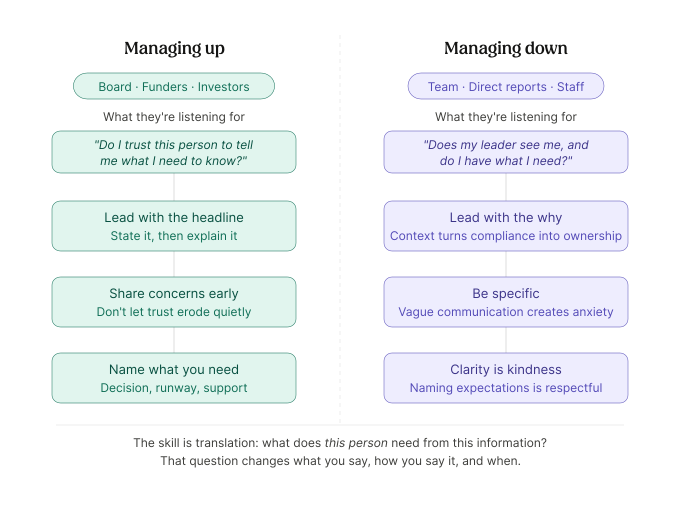
When you communicate up (to a board member, an executive director, an investor, or a funder) you're speaking to people who hold a different kind of stake in your work. They need enough context to make decisions and maintain confidence, but they are not in the day-to-day. What they're listening for, even when they don't say it directly, is: do I trust this person to tell me what I need to know?
When you communicate down (to your team, your direct reports, the people doing the work) you're playing a different role entirely. Here, your job is to orient people, remove ambiguity, and create the conditions for them to do their best work. What they're listening for is: does my leader see me, and do I have what I need?
The mistake most leaders make is applying the same approach to both.
What It Looks Like to Manage Up Well
Managing up well is not about managing perception. It's not spin, and it's not performed confidence.
It means leading with the headline. When you're in the weeds, it can feel natural to explain all the context before you get to the point. Resist this. Here's where we stand, here's what's driving it, here's what we're doing about it. Fill in the context after the headline if there's time.
It means sharing concerns before they become crises. I've watched leaders lose the confidence of their board simply because their communication was consistently one beat behind. Things were fine until they weren't, and by the time the board found out, trust had already started to erode. The work didn't cause the problem. The communication pattern did.
And it means being direct about what you need: a decision, more runway, a different kind of support. Don't assume the right offer will come if you just keep showing up prepared. The hardest version of this is when the news isn't good. The instinct is to lead with so much context that by the time you land on the actual news, the listener has been softened up for it. It doesn't work. People can feel when a lead-up is load-bearing.
Just say the thing. Then explain it.
What It Looks Like to Manage Down Well
With your team, the calculus flips. But it's not simply the reverse of managing up. It's a different job entirely.
Your team doesn't need the headline first. They need to understand why. Why this decision was made. Why the strategy shifted. Why this matters right now. Without that, even the clearest directive lands as noise, and people fill the silence with the most anxious interpretation available to them.
I've been on both sides of this. There's a particular feeling of being handed a decision from somewhere above you, with no context for how it got made, and being asked to carry it forward. You can do it. But something gets lost: the sense that you're part of something, that your judgment matters, that you're trusted with the real story. When I communicate down now, I ask myself: does this person have enough to actually understand what's happening, or are they just receiving instructions? Within your team, context is what turns compliance into ownership.
The second thing that matters more than most people expect: specificity. Vague communication, even when it comes from a kind or protective place, creates more confusion than directness does. When expectations are unclear, timelines aren't stated, or "success" isn't defined, people will make it up. And you'll find yourself weeks later in a conversation wondering how you ended up somewhere so different from where you thought you were heading.
Kindness and clarity are not in tension. Naming what you expect, by when, and what good looks like is one of the most respectful things you can do for someone doing hard work.
The Place Where Both Break Down
The pattern I see most often: a leader is under pressure from above, absorbs it, and then one of two things happens. They pass it downstream without translation, dumping a board's anxiety onto a team that has no context for it. Or they absorb it completely and say nothing, leaving their team operating without the full picture while the leader manages alone.
Neither is sustainable. And both are made significantly worse when there's no one in the organization to help carry the communications load: no one to pressure-test the message before it goes out, no one to flag when something critical is missing or when the tone is off.
I'm guilty of both patterns. The version I catch myself in more often is the quiet absorption one. My instinct when something is hard is to figure it out before I talk about it. But "I'll handle it and then update you" can look a lot like withholding from the outside, even when that's not the intent. My team has told me this directly. It's not comfortable feedback to receive, but it's some of the most useful I've gotten.
The skill, really, is translation. Not passing things up or down unchanged, but pausing to ask: what does this person need from this information? What will help them do their job, make their decision, or feel like a real part of what we're building? That question changes what you say, how you say it, and when.
Working With the Capacity You Actually Have
If you're reading this thinking I know I should do this, I just don't have the bandwidth, that's an honest response. And here's an honest answer: you probably can't build a communications infrastructure overnight. But a few small habits can protect the translation work even when you're stretched.
Pause before you send. Before any major update goes out, spend five minutes asking: who is reading this, and what do they need to be able to do with it? It doesn't need to be elaborate. Just a beat to check whether the outcome you want is aligned with what you've actually written.
Use templates for your most frequent communications. Board updates, all-staff messages, one-on-ones: the structure of these rarely needs to change. What changes is the content you pour into it. Templates don't reduce thoughtfulness. They protect your energy for the parts that actually require it.
Find one honest reader. A peer, a coach, a trusted colleague who will tell you when the headline is buried or something important is missing. You don't need a full communications review. You just need one person who can tell you the truth before the message goes out.
Name the translation gap out loud. Sometimes the most useful thing you can do is simply say to your team: "I'm still processing some of this, but here's what I know, here's what I don't, and here's how we're moving forward." That kind of transparency, even partial, tends to land far better than silence.
These aren't perfect solutions. They're ways to protect the communication work when your bandwidth is tight. And they work best when the underlying skill (knowing what each audience actually needs) is something you've had a chance to develop with intention, not just figure out in real time.
Something to Try This Week
Think about the most important communication you're sitting on right now: something going up, something going down, or both. Before you draft it, ask yourself three questions:
- Who am I actually writing this for, and what do they need to be able to do with it?
- What am I holding back (out of protection, or out of habit) that they'd probably be better off knowing?
- Am I giving them the headline, or am I making them wait for it?
You don't have to share everything. But the things that are true and matter deserve to be said clearly, and to the right person, in the right way.